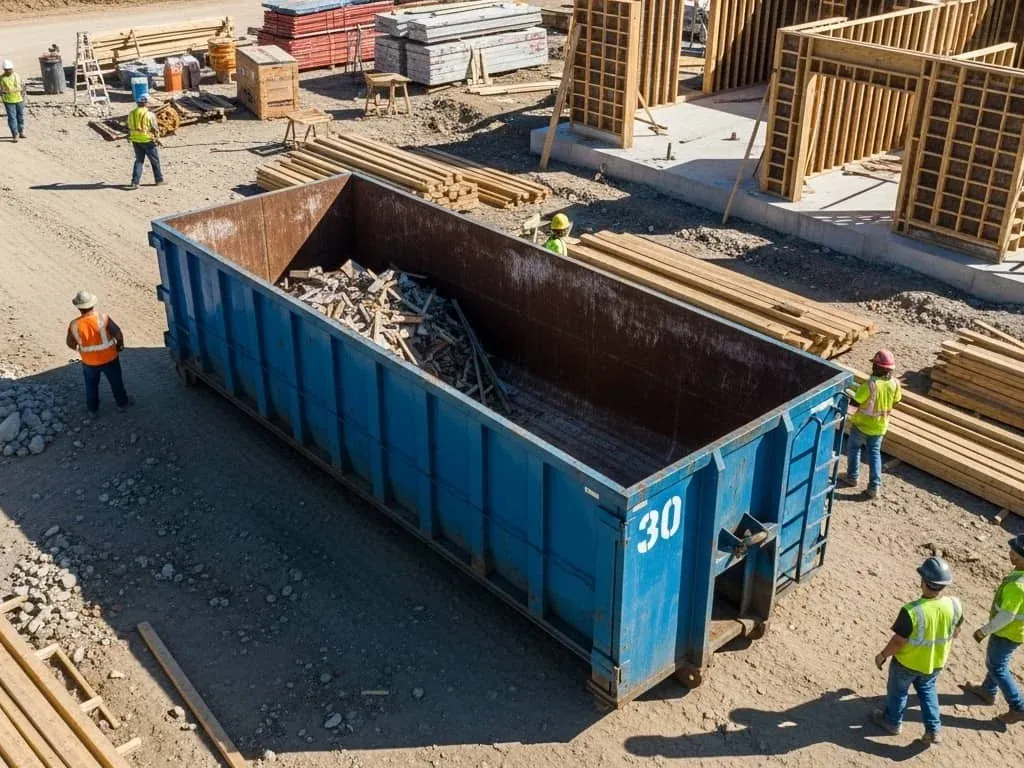

Winter Dumpster Rental in New Bedford: What to Expect
What changes when you rent a roll-off through a New Bedford winter: snow emergencies, nor'easters, frozen loads, and why deep winter is often the quieter window.
ReadNew Bedford, MA guide
A driveway drop usually needs no permit; a container on a New Bedford street usually does. Here is how the rules work and how to plan around them.
The question comes up on nearly every call we take from a New Bedford address, and it usually arrives in the same shape: "Do I need a permit for this thing?" The honest answer is that it depends almost entirely on where the container's wheels are going to sit. Private property is one set of rules. A public street is another set entirely, and in this city the street is far more often the only realistic option.
That is not a small distinction here. New Bedford's housing stock is dominated by triple-deckers and multi-family homes built long before anyone was designing for two cars per unit. Whole blocks in the North End, the South End and the neighbourhoods off Acushnet Avenue have no driveway at all, or a driveway so narrow that a loaded roll-off would block the only way in and out. When a homeowner in Dartmouth calls, the container usually goes on a paved apron beside the garage and nobody needs to involve city hall. When a landlord on a dense New Bedford side street calls, we are usually talking about occupying a parking space on a public way, and that changes the paperwork.
What follows is how we explain it to customers. We are a hauler, not a permitting authority, so treat this as the shape of the process rather than the letter of the law. Rules, fees and review steps differ by municipality and they change. Confirm specifics with the City of New Bedford or the town in question before you commit to a delivery date.
A container sitting entirely on private property — your driveway, your yard, a paved lot you own or control — generally does not require a municipal permit. Nothing public is being occupied. You still need to think about weight, surface protection and clearance, but you are not asking permission from the city.
A container placed on a public street, a sidewalk, a public parking space or any part of the municipal right-of-way generally does require a permit, issued by whichever body controls that road. For most residential streets in New Bedford, that is the city. In Dartmouth, Fairhaven, Acushnet or Westport, it is that town's own department, under that town's own rules, on that town's own timeline. There is no regional permit that covers the South Coast.
Some roads are state-numbered routes — stretches of Route 6, Route 18, Route 140 and Route 240 among them — and occupancy of a state highway layout can fall under MassDOT rather than the local department. If your frontage is on a numbered route, ask early, because that review is a different animal from a residential street permit. General state information lives at mass.gov, but the practical step is a phone call before you book.
| Where the container sits | Permit likely needed? | Who to ask |
|---|---|---|
| Your own driveway, fully off the road | Generally no | Nobody, but check your deed for shared driveway rights |
| Your own lawn or side yard | Generally no | Nobody, unless wetlands or a flood zone are involved |
| Public street or parking space in New Bedford | Yes, in most cases | City of New Bedford |
| Public sidewalk or tree belt | Yes, and often refused | City of New Bedford |
| Street in Dartmouth, Fairhaven, Acushnet, Westport | Yes, under that town's rules | That town's highway or public works office |
| Frontage on a state-numbered route | Possibly, via state review | The town first; they will point you to MassDOT if needed |
| Condo, apartment or association common area | Usually no city permit, but yes to owner approval | Association trustees or property manager |
| Commercial lot you lease | Generally no city permit | Your landlord, in writing |
| Waterfront lot near a resource area | Possibly | That town's conservation commission |
The details vary by municipality, and we are deliberately not going to quote fees or form numbers we cannot stand behind. Broadly, though, applications of this kind ask for the same handful of things.
Apply earlier than you think you need to. Municipal offices work on their own calendar, and a permit that arrives after your contractor's start date helps nobody. If your project is time-sensitive, call us about scheduling before you file, and read our notes on roll-off container service so you know what will actually be turning onto your street.
On a New Bedford street with resident permit parking, a container removes something people genuinely rely on. One 20-yard box takes a space, sometimes two once you account for the truck's swing and the clearance a driver needs to load. On a block of triple-deckers, that can be a dozen households competing for what is left.
Knock on doors first. It takes ten minutes and prevents most of the friction. Tell your neighbours the dates, and mean them. Beyond that, three habits keep street rentals from turning sour: size the container to the job instead of ordering the biggest thing available, keep the rental period genuinely short, and book a swap rather than letting one box sit half-full for three weeks. Two short rentals with a swap between them are almost always better neighbours than one long one. Our size guide and the sizing walkthrough will get you close; for a single-room clearout on a tight street, a 10-yard container often does the job with a much smaller footprint.
Around the Whaling National Historical Park the ground itself changes. Cobblestones, narrow one-ways, granite curbing and buildings that predate trucks entirely. Two things follow. First, access is a real engineering question — some of those streets cannot take a loaded truck's turning radius, and we would rather tell you that on the phone than discover it with a driver idling at the corner. Second, work in and around designated historic areas can draw additional review beyond a standard street permit.
If your address is in or near that district, check before you book. Ask the city whether your placement triggers extra review, and call us so a driver can assess the approach. Both conversations are short. Both save days.
This is the one that catches people. When the city declares a snow emergency, on-street parking rules change fast, and a container occupying a public space can be required to move at short notice. Plows need the width. A steel box that cannot be relocated in a few hours becomes the renter's problem.
From December through March we push customers hard toward private-property placement wherever it is physically possible, and toward shorter rental windows when it is not. If you must be on the street in winter, keep our number on the fridge and answer the phone. There is more on cold-weather logistics in our winter rental guide.
A city permit is not the only approval that matters. If you live in a condo, the association almost certainly controls the common areas and the parking lot, and trustees frequently impose conditions the city never would — specific spaces only, weekday hours, a plywood requirement, a hard end date. Tenants in a multi-family building need the owner's sign-off before anything lands on the property.
Get it in writing. An email from the property manager is enough. We have had deliveries turned around at the curb by a trustee who did not know it was coming, and that is a wasted trip for everyone. Property managers running larger buildings can look at our commercial service, and we can stage bigger multi-unit clearouts across several swaps.
Out toward the water the constraints shift again. In Mattapoisett, Marion and Westport, and along the shoreline generally, properties sit near wetlands, coastal banks and mapped flood zones. Local conservation commissions have jurisdiction over activity within buffer zones, and heavy equipment or debris storage near a resource area can require review even when the container never touches a public road.
Soft ground is the other coastal issue. Sandy or saturated soil does not hold a loaded container well, and a truck that sinks is a bad afternoon. Tell us what the surface is like when you book. The full list of towns we cover sits in our service area section.
The simplest permit is the one you never file. Where there is any private surface available, use it. A driveway apron, a spot behind a fence, the corner of a parking lot, a neighbour's yard two doors down with their written permission — all of these keep you off the public way. Measure first: most roll-offs need roughly the length of a car and a half, plus room for the rear door to swing and overhead clearance for the truck to raise the box.
Protect what you park on. Plywood or thick planks under the wheels and the rear rail spread the load and spare your asphalt, especially in July heat; our guide to protecting your driveway goes through it properly. And be realistic about the load — our Massachusetts disposal rules rundown covers the banned items that get a container rejected at the scale.
If you are not sure which category your address falls into, call us before you file anything. We run these streets every week, our drivers know which blocks a truck can actually work, and we will tell you straight whether you are looking at a private-property drop or a street permit. Call Bedford Bros Dumpster Rental at (508) 501-1638 and we will talk through placement, timing and the paperwork you will need before you book.
Talk to a real person
Call and describe the job. Flat price, stated tonnage, and a delivery time on the same call.
Mon–Sat 7:00am – 6:00pm · Sun by appointment
From this guide
Generally no. A container sitting entirely on private property you own or control does not usually require a municipal permit, because nothing public is being occupied. Confirm with the City of New Bedford if anything about your placement is unusual, and check whether a shared driveway or deed restriction limits what you can park there.
Then you will typically need a street-occupancy permit from the city. This is common in New Bedford because so many triple-deckers and multi-family homes have no driveway. Apply early, expect conditions covering exact placement, dates and overnight safety marking, and ask us for our insurance certificate before you file.
Each municipality runs its own process. Dartmouth, Fairhaven, Acushnet, Mattapoisett, Marion, Westport, Freetown and the rest all have separate rules, offices and timelines. There is no regional South Coast permit. If your frontage sits on a state-numbered route, the town may direct you to MassDOT instead. Call before booking.
A declared snow emergency can change on-street parking rules quickly, and a container in a public space may need to move at short notice so plows have room. Plan around it. From December through March we push customers toward private-property placement where possible, and toward shorter rental windows when the street is unavoidable.
Almost always, and that approval is separate from any city permit. Associations control common areas and parking lots, and trustees often set stricter conditions than the city would. Tenants need the owner's sign-off. Get it in writing before delivery day. We have had trucks turned around at the curb over missing approval.
Keep reading
What changes when you rent a roll-off through a New Bedford winter: snow emergencies, nor'easters, frozen loads, and why deep winter is often the quieter window.
ReadA working guide to sizing, sequencing and source-separating construction debris containers on New Bedford jobsites, from plaster demo tonnage to MassDEP waste bans and swap scheduling.
ReadA calm, ordered plan for clearing a family home on the South Coast: authority and valuables first, a proper search, Massachusetts sorting rules, and realistic container sizing.
Read