
Home Cleanout Checklist New Bedford: Room-by-Room Plan
A room-by-room cleanout plan built for New Bedford housing: book the container first, stage in four zones, and start in the basement rather than the memories.
ReadNew Bedford, MA guide
Driveway damage during a roll-off rental happens in two moments, not two weeks. Where the risk sits, what protection works, and how to time it seasonally.
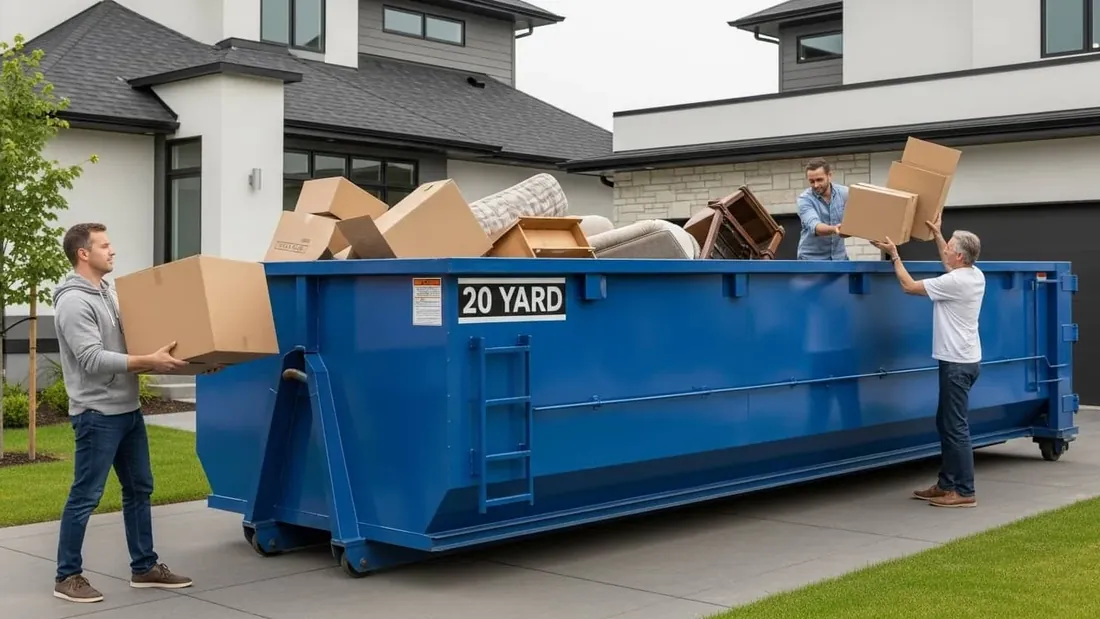
People worry about the wrong part. The call we get is almost always some version of "how much weight is that thing going to put on my driveway while it sits there?" — and the honest answer is that a container parked still, spread over its full length of rails, is not what cracks a surface. A loaded twenty-yard box resting on two long steel rails distributes its weight over a lot of square inches. It is the two moments either side of that quiet fortnight where every bit of real risk lives: the roll-off and the pick-up.
Watch it happen once and you understand. The truck backs in, the hoist tilts, and the back of the container comes down onto a pair of rollers no wider than your hand. For a few seconds thousands of pounds of steel ride on those two contact points while the box drags backward across the surface. Pick-up is the same in reverse, except the container is now full and the winch is pulling all of that weight up and forward while the rollers scrape and the rails skid. Add the truck itself, rear axle group carrying most of the load, sitting on your apron at the instant of maximum stress. That is the whole story, compressed into forty seconds twice per job.
The pattern after a decade of this is consistent. Careful placement with boards down, on a surface that was sound to begin with, almost never leaves a mark. But New England hands us surfaces that are frequently not sound to begin with, and that is the part nobody can wish away. The driver's first ninety seconds on foot, before the truck moves an inch, matter more than anything else all week.
Freeze-thaw cycling is the single biggest enemy of a driveway in this part of the country, and it does its work long before any truck shows up. Water finds a hairline crack in asphalt or a joint in concrete, freezes, expands, and levers that crack wider. Then it thaws and does it again — dozens of cycles in a Bristol County winter, not one. Road salt accelerates the same process. By March a driveway that looked fine in November can be spalling at the edges and crazed through the middle.
Then the thaw arrives and the ground underneath goes soft. Subgrade that carried a loaded truck comfortably in January turns saturated and yielding by late March. A surface is only as strong as what supports it, and a compromised surface over a saturated base is the worst combination we deal with. The season you rent in matters as much as the surface you own.
Boards. That is genuinely most of it. Planks or sheets of plywood laid under the rails and at the roller contact points, placed before the container touches the surface, spread that concentrated load across a far bigger footprint. We put boards under the rails on every driveway placement as standard and it is not an upsell — it is just how a container should be set. Anyone charging extra for it is charging you for basic care.
The rest is judgement. A driver who walks the spot first, looking for hairline cracks, the sunken patch, the drain cover, the septic lid. Setting the box square so both rails bear evenly instead of one rail carrying it on a twist. Keeping the container off the apron edge, almost always the thinnest and least supported part of any driveway. Staying clear of expansion joints, catch basins and utility covers. And picking a spot where the truck can back straight in, because steering a loaded truck on your surface grinds tyres sideways and does more harm than the container ever will.
Asphalt is the most common driveway on the South Coast and the most variable. It softens in summer heat — genuinely softens, to where you can press a thumbnail into it on a July afternoon — and after a winter of freeze-thaw and salt it is often already cracking. Poured concrete is the strongest surface we set on, but its weak points are specific: control and expansion joints, and thin aprons at the street edge where the sub-base was never properly compacted. Pavers and stamped concrete carry the highest risk of anything, because individual units shift and decorative surfaces show every scuff. Gravel and unpaved rural drives — common out toward Rochester, Freetown, Lakeville and Middleborough — do not crack, they rut, and in spring they rut deep.
| Surface | Risk level | Recommended precaution |
|---|---|---|
| Asphalt, sound and under 10 years old | Low to moderate | Boards under rails and rollers; morning placement June through August |
| Asphalt, cracked or spalling after winter | High | Boards plus wider plywood spread, or move to the street; expect existing cracks may worsen |
| Poured concrete, full-depth slab | Low | Boards; keep rails clear of expansion joints and off the thin apron |
| Concrete apron or thin edge pour | Moderate to high | Set the box fully onto the main slab, never bridging the apron lip |
| Pavers, cobble, stamped or decorative concrete | Highest | Place elsewhere if at all possible — street, lawn edge or a smaller box on a side pad |
| Gravel or crushed stone | Moderate | Boards for the rails; accept some regrading; avoid the spring thaw window |
| Unpaved dirt rural drive | High in spring, low when firm | Deliver on frozen or dry ground only; consider a smaller container |
| Recently sealcoated or resurfaced (under 12 months) | High | Wait if you can; scuffing and marking are likely regardless of protection |
Better than people expect. Frozen ground is genuinely firm and carries a loaded truck well — a hard-frozen gravel drive in January is more stable than the same drive in April. The catch is that snow has to be cleared to bare surface before delivery, and ice hides everything the driver would otherwise see on the walk-around. We cover the rest of the cold-weather logistics in our winter rental guide.
The worst window of the year, and it is not close. Late March into April gives you a surface at its most damaged from freeze-thaw and salt, sitting on subgrade that is saturated and soft. Both failure modes are live at once: cracking on top, rutting underneath. If a job can wait three weeks in spring, it should.
Asphalt softening is the only real issue and it is easily managed. We favour a morning placement in a July or August heat wave, before surface temperature climbs, and the same for pick-up where we can arrange it.
The best conditions of the year. Dry ground, firm subgrade, moderate temperatures, no frost heave. If you are planning a home project with any flexibility on dates, September and October are what you want.
This is New Bedford, so it is not an afterthought. Triple-deckers and multi-family houses frequently have no driveway whatsoever, or one narrow shared strip serving three units. Street placement with a permit is standard here and is often the better outcome anyway — city pavement is built for truck traffic in a way your 1962 apron is not. Our permit walkthrough covers how that process works.
On a shared drive, sort it with the neighbours before you book, not on delivery morning. Agree where the box sits, agree that it will not block anyone in, and get it settled. And be open to a smaller container purely for placement reasons: a 10-yard box fits places a 30 simply cannot, needs less straight-line approach, and puts less load down on the way in. Compare footprints on the size guide before you decide.
The homeowners who never have a problem mention things upfront. Slope, especially anything that makes the truck work to back up. Soft ground or a spot that ponds after rain. Low branches and overhead service cables — a hoist goes higher than people picture. Gate width. Septic lids and leach field lines, a genuine issue out toward Westport and Freetown. Irrigation heads. Buried utilities. Anything sealcoated or resurfaced in the last year. And anything decorative — pavers, cobble edging, a stamped border. None of it is a deal-breaker. All of it changes where we put the box.
What goes in the container decides how hard pick-up is on your surface. Concrete, brick, dirt, asphalt shingles and plaster-and-lath are dense, and a full box of any of them is dramatically heavier than the same box of household furniture. That is the main reason we put heavy material in a smaller container — see heavy debris loads and our roofing tear-off sizing notes. A 10 or 15-yard box loaded with masonry is easier on a driveway at winch-up than a 30 loaded with the same, and it keeps you inside legal road weight too.
A careful hauler, boards down, a well-chosen spot and a sensible season: damage is rare. We set containers across New Bedford, Dartmouth, Fairhaven, Acushnet, Mattapoisett, Marion, Fall River and the rest of the South Coast towns we serve week in and week out without incident. But nobody honest will promise a compromised surface comes through untouched. A driveway already cracked, spalling or lifting from years of freeze-thaw is at elevated risk whatever anyone does with plywood, and the sandy coastal subgrade in South Dartmouth and Mattapoisett behaves differently from the glacial till inland. If your surface is marginal, tell us, and we will talk about the street instead.
Not sure where a box should go at your place? Call the yard at (508) 501-1638 and describe the driveway — surface, width, slope, what is buried under it. Our drivers will tell you straight whether it is a driveway job, a street job with a permit, or a case for a smaller container. More detail on how we work is on our about page, and common questions are answered on the FAQ.
Talk to a real person
Call and describe the job. Flat price, stated tonnage, and a delivery time on the same call.
Mon–Sat 7:00am – 6:00pm · Sun by appointment
From this guide
Rarely. A container at rest spreads its weight along two long steel rails, which is a large contact area. The real stress happens during delivery and pick-up, when the load concentrates onto small rollers and the box drags across the surface. That is why boards go under the rails and roller points before the container ever touches your driveway.
No. Planks under the rails are standard on every driveway placement we make, never an add-on. It is basic care, not a product. Our drivers also walk the spot before backing in to check for cracks, drain covers, septic lids and soft patches, and they set the box square so both rails carry weight evenly.
Late March into April, the spring thaw. The subgrade underneath is saturated and soft while the surface itself is at its most damaged after a winter of freeze-thaw cycling and road salt. Both cracking and rutting are most likely then. Autumn gives the best conditions of the year, and frozen winter ground is firmer than most people expect.
We can, but we usually recommend against it. Pavers and stamped or decorative concrete carry the highest risk of any surface because individual units shift under concentrated load and scuffing shows badly. Better options are street placement with a permit, a firm spot off the decorative area, or a smaller container that needs less room to maneuver.
Street placement with a City of New Bedford permit is standard and very common here, and city pavement handles truck loads better than an old apron anyway. Shared drives work if neighbours agree on the spot beforehand. A smaller container also opens up placements a larger box cannot reach. Call us and we will work it out.
Keep reading
A room-by-room cleanout plan built for New Bedford housing: book the container first, stage in four zones, and start in the basement rather than the memories.
ReadWhat happens to a New Bedford dumpster load after pickup, how Massachusetts waste bans route each material, and the sorting that actually cuts your disposal bill.
ReadHow to choose between 10, 15, 20, 30 and 40 yard roll-offs in New Bedford: real dimensions, tonnage limits, tight-driveway clearances and six worked jobs.
Read