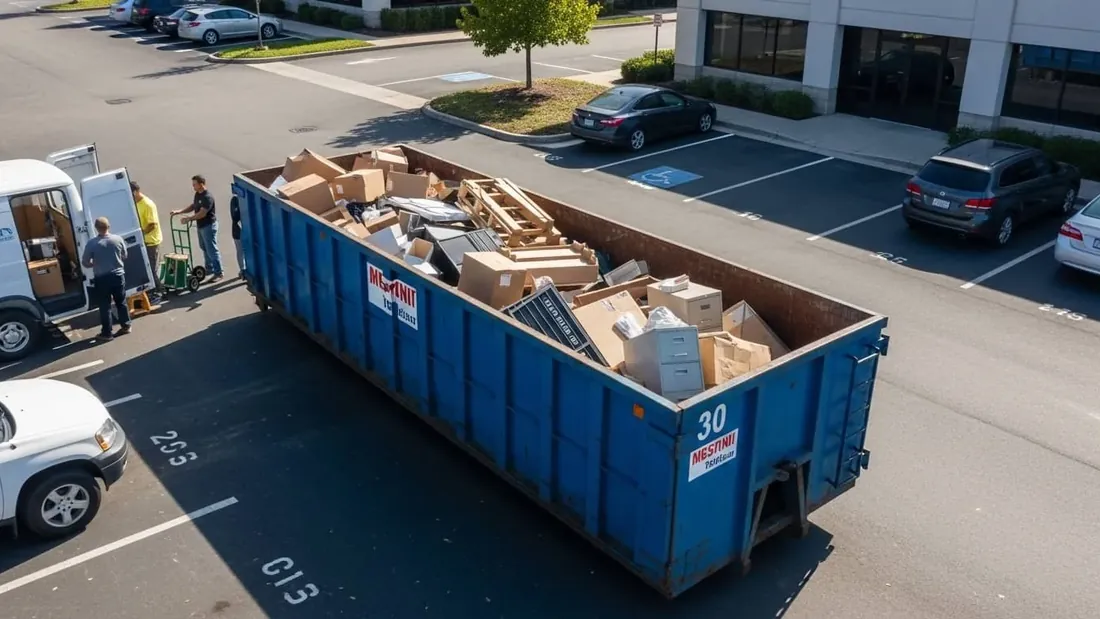
Dumpster Rental Cost in New Bedford, MA: Real Numbers
An operator's breakdown of New Bedford dumpster pricing: what a flat rate should include, the add-ons to ask about, and why weight decides your bill.
ReadNew Bedford, MA guide
How to choose between 10, 15, 20, 30 and 40 yard roll-offs in New Bedford: real dimensions, tonnage limits, tight-driveway clearances and six worked jobs.
Every week somebody calls the yard and opens with "I just need the big one." Nine times out of ten they don't. Sizing a roll-off is a two-variable problem — how much room the debris takes up, and how much it weighs — and most people only think about the first one. Guess low and you pay for a second haul. Guess high on heavy material and you pay overage on a box that is two-thirds air.
New Bedford makes the volume half harder than it should be, and the weight half harder still. Triple-deckers sitting on forty-foot lots. Driveways laid out for a 1962 sedan. Side streets off Acushnet Avenue and County Street where the curb is full by four in the afternoon. And behind the walls of most of the housing stock in this city: plaster over wood lath, not drywall. Plaster runs roughly three times the weight of the same volume of gypsum board. One 12-by-14 room stripped to the studs in a 1910 three-family will put more on the scale than an entire attic of cardboard, boxes and bedroom furniture.
So the real answer to "what size do I need" starts with what the material is, not how big the job feels. Below is what each container actually holds, how the tonnage allowance works, six jobs we run constantly on the South Coast, and the one situation where the standard advice — always go one size up — reverses hard.
Dimensions vary a little between manufacturers, but these are close to what rolls off our trucks. Note that 20, 30 and 40 yard boxes are usually the same 22-foot footprint — the difference is wall height, not ground space. That single fact decides a lot of New Bedford jobs.
| Size | Typical dimensions (L x W x H) | Pickup loads | Typical tonnage allowance | Best for |
|---|---|---|---|---|
| 10 yard | 12' x 8' x 3.5' | 3 | 1–2 tons | Concrete, brick, dirt, plaster gut of one room, small bath tear-out |
| 15 yard | 16' x 8' x 4' | 4–5 | 2 tons | Kitchen remodel, one-layer roof under 20 squares, garage clear-out |
| 20 yard | 22' x 8' x 4.5' | 6 | 2–3 tons | Roof tear-offs, apartment cleanouts, mid-size remodels, deck removal |
| 30 yard | 22' x 8' x 6' | 9 | 3–4 tons | Whole-house renovation, three-unit cleanout, commercial fit-out |
| 40 yard | 22' x 8' x 8' | 12 | 4 tons | Light, bulky volume only — siding, insulation, cabinetry, retail strip-out |
Walk the sizes in detail on the size comparison hub, or straight to the 10 yard, 15 yard, 20 yard, 30 yard and 40 yard pages.
Our pricing is flat rate with a stated tonnage allowance baked in. You know the number before the truck leaves Church Street. Everything that goes out of here crosses a certified scale, and if the load comes in over the allowance the excess is billed per ton at a rate we quote you up front — no surprise line items, no invented fees.
The trap is that a 30 yard box does not come with three times the weight room of a 10. It comes with roughly twice. Volume scales faster than the allowance does, because the allowance is limited by what a truck can legally carry on Route 18 and I-195, not by how tall the walls are. Fill a 30 with plaster and you will be over the allowance long before the box looks full — and if it is over the legal axle weight, our driver cannot lift it at all. That is the moment a job stalls.
Rule of thumb from the yard: if you can pick up a five-gallon bucket of the stuff and it strains you, you are sizing by weight, not by volume.
Bathroom or one bedroom in a Fairhaven ranch: 10 yard. Same room in a North End triple-decker with plaster and lath: still a 10, and you may need it swapped rather than upsized. Tile, cast-iron tub, wet subfloor and plaster add up faster than anyone expects.
Asphalt shingles run roughly 250–300 lbs per square (100 sq ft) per layer. A 20-square single-layer roof is around 2.5–3 tons. Two layers doubles it. We send a 20 yard for most single-layer jobs and never a 40, no matter how big the roof is — see the roofing debris page for layer-by-layer numbers.
One unit of furniture, mattresses, clothing and household junk: 20 yard. All three floors at once: 30 yard. Mattresses and textiles have been banned from disposal in Massachusetts since November 2022, so those come out separately — tell us the count when you book.
Gutting a Victorian off County Street or a cottage in Acushnet: 30 yard for the light demo phase, plus a 10 yard staged for plaster, tile and chimney brick. Two boxes, two purposes, one trip cheaper than a stalled 30 that cannot be lifted.
Downtown storefront or an office suite: 30 yard handles ceiling grid, partition framing, carpet and cabinetry. If the strip-out includes slab work, split it. Ceiling tile and carpet are light; the slab is not.
Seasonal properties in Mattapoisett, Marion and Westport come with damp furniture, salt-rotted decking and thirty years of accumulated garage. A 20 yard covers most turnovers. Water-logged material weighs far more than dry — a soaked sectional can double.
The advice is sound for bulky, light material. Furniture, boxes, cabinetry, insulation, siding, deck boards, brush. Under-ordering there means a second delivery fee, which always beats the small step in price between one size and the next. Go up.
It reverses the moment the load is dense. For plaster and lath, concrete, brick, asphalt, ceramic tile, dirt, roofing shingles or wet carpet, going up buys you room you are not allowed to use and a bigger overage bill when you use it anyway. Concrete alone runs about 4,000 lbs per cubic yard — ten yards of it is twenty tons, which no roll-off truck in Bristol County is putting on the road. Heavy material means a smaller box, a fill line partway up the wall, and often a swap-and-return. That is why we run dedicated concrete and heavy debris containers instead of pretending a big box solves it.
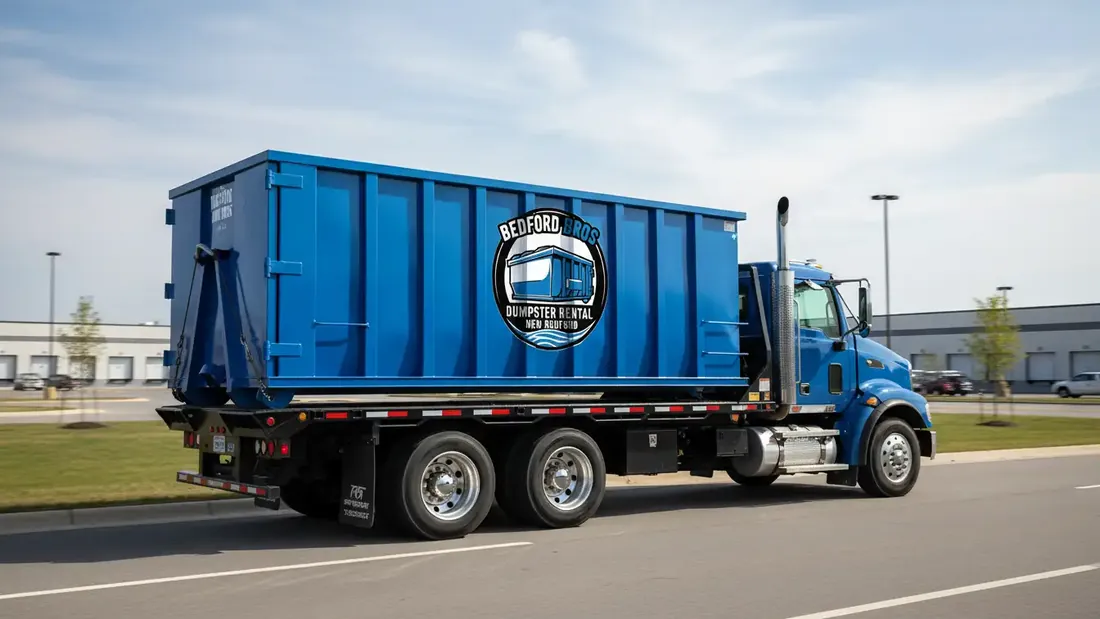
Here is where New Bedford diverges from a subdivision in Raynham. The box itself is only half the space you need. Our driver needs roughly 60 feet of straight, clear run to roll a container off the truck and set it down — more like 70 for a 30 or 40. Overhead we need about 25 feet of clear vertical space for the hoist, which rules out low limbs, service drops and the wires that cross a lot of the older streets in the North and South Ends. Width, figure 10 to 12 feet with mirrors.
Then the barn doors. Every size on this list has rear doors that swing wide so you can walk debris in instead of heaving it over a four-foot wall, and they need 4 to 5 feet of clearance behind the box to open. On a narrow triple-decker driveway with a fence line, that clearance is the whole ballgame. Tell us which way the doors need to face when you book — we set the container so they open toward your work, not toward the neighbour's hedge.
If the driveway will not take it, the street is the fallback, and street placement in New Bedford means a permit. Read the permit walkthrough before you plan around on-street parking, especially in the historic district and anywhere near the waterfront where the working schedule is tight.
Every driveway placement gets boards under the rails. No exceptions. Freeze-thaw already does enough damage to South Coast asphalt without eight tons of steel parked on it through a nor'easter.
MassDEP bans a long list of materials from disposal, and it genuinely changes what fits in a container here compared with most of the country. Asphalt pavement, brick and concrete. Metal. Clean gypsum wallboard. Treated and untreated wood from construction and demolition. Leaves and yard waste. Whole tires. Mattresses and textiles as of November 2022. None of that is a reason to panic — it is a reason to tell us the material list on the phone, because separated streams often mean a smaller box and a cheaper job. Full detail sits in our guide to what can and cannot go in a dumpster in Massachusetts, and the official list lives at mass.gov.
We deliver across New Bedford, Dartmouth, Padanaram, Fairhaven, Acushnet, Mattapoisett, Marion, Rochester, Freetown, Westport, Wareham, Fall River, Somerset, Swansea, Lakeville, Middleborough, Berkley and Raynham, most of it same day when you call early. Tell us the address, the material and the driveway, and we will tell you the box — even when it is smaller than the one you were about to order. Call (508) 501-1638.
Talk to a real person
Call and describe the job. Flat price, stated tonnage, and a delivery time on the same call.
Mon–Sat 7:00am – 6:00pm · Sun by appointment
From this guide
One unit of furniture, boxes and household junk usually fits a 20 yard container. Clearing all three floors at once calls for a 30 yard. Set mattresses and textiles aside before you load, since Massachusetts has banned both from disposal since November 2022, and tell us the count when you book so the right container arrives.
Plaster over wood lath weighs roughly three times what the same volume of drywall weighs, and most older New Bedford housing has it. A single gutted room can outweigh a whole attic of furniture. That density means you order a smaller box with a fill line partway up the wall, not a bigger one, and plan on a swap if there is more.
Plan on about 60 feet of straight clear run for delivery and pickup, 70 for a 30 or 40 yard. Overhead you need roughly 25 feet clear for the hoist, so watch limbs and service wires. Allow 10 to 12 feet of width, plus 4 to 5 feet behind the container for the rear barn doors to swing open.
Only for light, bulky material. Siding, insulation, cabinetry, ceiling grid, a retail strip-out. It is a volume container, not a weight container, and it shares the same 22-foot footprint as a 20 or 30 with taller walls. Load anything dense into one and you will hit the tonnage allowance and the legal axle limit long before the box is full.
Every load crosses a certified scale on the way out. Weight beyond the allowance included in your flat rate is billed per ton at a figure we quote before the truck rolls, so nothing is a surprise. The bigger problem is an overloaded container our driver legally cannot lift, which stalls the job. Call if you are unsure and we will size it down.
Keep reading
An operator's breakdown of New Bedford dumpster pricing: what a flat rate should include, the add-ons to ask about, and why weight decides your bill.
ReadMassachusetts bans a long list of materials from disposal. A New Bedford operator walks through what goes in a container, what never does, and what contamination really costs.
ReadA driveway drop usually needs no permit; a container on a New Bedford street usually does. Here is how the rules work and how to plan around them.
Read