

Estate Cleanout Checklist for New Bedford Families
A calm, ordered plan for clearing a family home on the South Coast: authority and valuables first, a proper search, Massachusetts sorting rules, and realistic container sizing.
ReadNew Bedford, MA guide
A working guide to sizing, sequencing and source-separating construction debris containers on New Bedford jobsites, from plaster demo tonnage to MassDEP waste bans and swap scheduling.
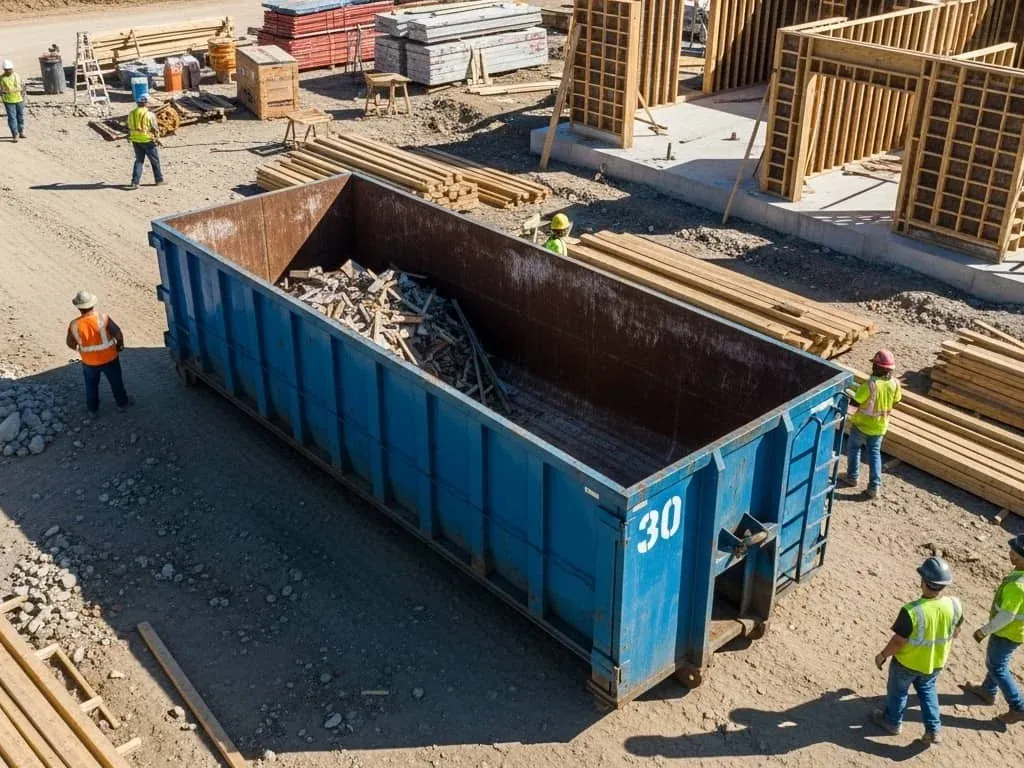
Household junk is a volume problem. Construction debris is a weight problem wearing a volume costume. A 30 yard box full of couches, boxed clothing and yard furniture might come off a New Bedford driveway at two tons. The same box loaded with plaster-and-lath off a Church Street triple-decker can go over the scale at eight, and it never even looked full. That gap between what a container looks like and what it weighs is where most jobsite disposal budgets quietly bleed out.
The second thing that separates a build from a cleanout is Massachusetts itself. MassDEP maintains a list of materials banned from disposal, and four of them sit at the centre of almost every renovation on the South Coast: asphalt pavement, brick and concrete (ABC); metal; clean gypsum wallboard; and wood from construction and demolition, treated and untreated. Add leaves and yard waste, whole tyres, mattresses and textiles. In practice that means source separation on a Massachusetts jobsite is not a nice-to-have or a green initiative. It is the operating condition, and it is the single biggest lever you have on disposal cost.
Third: our building stock fights back. Balloon-framed multi-families, three-storey walk-ups on twenty-foot side yards, old-growth framing denser than anything at the lumberyard today, plaster keyed over wood lath, and asbestos and lead-paint exposure on anything pre-1980. Everything below is written for that, not for a suburban new-build.
The instinct is to price the whole project, order the biggest box and let it sit for eight weeks. On a tight urban lot that is usually the most expensive way to do it. Debris does not arrive at a constant rate or density. It arrives in phases, and each phase wants a different container.
Strip-out and rough framing generate enormous bulk that weighs relatively little per cubic yard: cabinetry, sheathing, subfloor, packaging, offcuts. This is where a 30 yard roll-off or a 40 yard earns its keep, provided you have the frontage to set it. The exception is plaster demo, covered below, which flips the maths entirely.
Board scrap, setting compound buckets, thinset, backer board and tile go dense in a hurry. A 20 yard is the right box here, and it will often hit tonnage before it hits the top rail. Bigger is not better when the constraint is weight — you are just renting air you cannot legally fill.
Packaging, trim offcuts, flooring underlay, paint-related waste, the endless cardboard. Low weight, steady trickle, and it fouls up a clean stream faster than anything else on site. A 10 yard or 15 yard on a scheduled swap handles this without a big box blocking your finish deliveries.
Staging two or three containers across the build usually beats parking one 40 for the duration. You are not paying idle rent on a box that sat empty for the eleven days the electrician had the site. You get clean separation by phase almost for free, because each phase naturally produces a different stream. And you keep the largest container on site only during the window when you can actually fill it fast. Our construction debris service is built around that rhythm; see the full size range if you want the dimensions side by side.
Rules of thumb, not gospel — every load is different and the scale is the final word. But these are the ones that surprise crews.
| Material | How it loads (rule of thumb) | Container that suits |
|---|---|---|
| Plaster and wood lath (pre-war triple-decker) | Several times the weight of modern drywall per cubic yard. A single gutted floor can exhaust a tonnage allowance. | 10 or 15 yard, swapped often |
| Modern gypsum wallboard, clean | Moderate, but doubles when wet | 20 yard, kept dry and uncontaminated |
| Concrete, brick, masonry, asphalt | Extremely heavy; fills a weight limit at ankle depth | 10 yard heavy-debris box, ABC only |
| Old-growth framing lumber | Noticeably denser than kiln-dried modern stock; nails add up | 30 yard, C&D wood stream |
| Asphalt shingles, tear-off | Very heavy per square; layers multiply fast | 15 or 20 yard — see roofing tear-off |
| Ceramic and porcelain tile, thinset, backer | Heavy, sharp, awkward to level | 10 or 20 yard |
| Insulation, carpet, pad | Light dry, heavy wet — soaks like a sponge | 30 yard, tarped |
| Rain- or snow-loaded mixed debris | Can add tons with no visible volume change | Any — tarp it |
Plaster deserves its own warning. Crews who have only worked modern housing order a 30 for a full gut on a three-decker and are astonished when we tell them to stop loading at a third. Three coats keyed over lath, a century of it, plus the lath — closer to masonry than to drywall. Plan tonnage first, volume second.
The banned streams that matter to a builder: ABC (asphalt pavement, brick, concrete), metal, clean gypsum wallboard, and C&D wood, treated and untreated. Those cannot go to disposal mixed in with everything else. The MassDEP waste ban list is public reading and worth ten minutes of your time at mass.gov.
The obvious answer is four containers. On a corner lot in Mattapoisett or a jobsite off Route 88 in Westport, fine. On a twenty-two foot wide lot in the North End with two parked cars and a shared driveway, impossible. So you separate across time instead of across space.
Give the yard the sequence when you book, not when you call for the swap. If we know Tuesday is metal-out and Thursday starts the plaster, we schedule around it. That is the difference between a planned swap and a truck you are waiting on. Same-day swap-outs exist — see same-day service — but they work best as a backstop, not a plan.
Contamination is expensive here in a way it is not everywhere. A load that should have been a clean single stream and arrives mixed gets handled as mixed, and the difference lands on your invoice. One drywall sheet in the ABC box, one length of PVC in the metal, and the economics of the whole container change. Our Massachusetts materials guide goes stream by stream.
Nothing above the rail. A heaped container cannot be tarped, and an untarped roll-off cannot legally travel — our driver will refuse it, and you have paid for a dry run and lost a day. Break bulky items down so they lie flat. Keep dense material low and toward the middle, not stacked at the back door. Walk the box and knock the peaks down before you call.
On anything built before 1980 on the South Coast, assume asbestos is present until a licensed inspector says otherwise. Pipe insulation, boiler wrap, floor tile and its mastic, siding, some joint compounds, roofing felt. Asbestos is prohibited in any container we place, full stop. It is licensed abatement work with its own handling and disposal chain, and it must be resolved before demolition begins — not discovered halfway through a gut. Lead paint is a separate regulated matter on these same houses and governs how you may disturb painted surfaces; EPA's guidance on lead is the starting point. Neither is something to find out about with a reciprocating saw already running.
An open container is a rain gauge with a bill attached. Drywall, insulation, carpet, pad and untreated timber all drink, and water weighs what water weighs. A nor'easter across an uncovered 30 yard of gutted material can add real tonnage overnight for zero extra volume. Freeze-thaw then locks the load into a solid mass that is miserable to tip. Tarp before every forecast, not after. More on the seasonal side in our winter rental notes.
On-street placement is normal here and needs a permit — sort that before delivery day, not while the truck idles on Route 18. Our permit walkthrough covers it. Leave a clear approach and overhead room; low wires and street trees end more deliveries than tight kerbs.
Tell us your expected fill rate up front — "we'll fill this in three days, then it's quiet for a week" — and swaps get scheduled instead of chased. That is the whole trick. We run commercial and contractor work across Dartmouth, Fairhaven, Acushnet, Mattapoisett, Fall River and the rest of the South Coast; the full service area is here.
If you are running more than one site, open an account. Priority on swaps when the schedule tightens, consistent pricing across every job, certificates of insurance kept on file so you are not chasing paperwork the morning of a delivery, and consolidated invoicing instead of a stack of one-off tickets. Who we are, and common questions.
Planning a gut, a tear-off or a multi-phase build on the South Coast? Call the yard, tell us the building's age, the phases and your frontage, and we will spec the sequence with you before the first container lands. Get in touch or call (508) 501-1638.
Talk to a real person
Call and describe the job. Flat price, stated tonnage, and a delivery time on the same call.
Mon–Sat 7:00am – 6:00pm · Sun by appointment
From this guide
Size by phase rather than by the whole job. Plaster-and-lath weighs several times modern drywall, so a 10 or 15 yard swapped frequently usually beats one big box that hits its tonnage allowance a third full. Framing and general demo suit a 30 yard. Tell us the building's age when booking and we will spec the sequence.
Yes, in practice. MassDEP bans several materials from disposal, including asphalt pavement, brick and concrete, metal, clean gypsum wallboard, and construction and demolition wood, treated or untreated. Those streams have to come out of the mixed load. Separation is the biggest single lever on your disposal cost, not a formality you can skip.
Separate across time instead of space. Pull metal first and stockpile it compactly. Run a small heavy box for asphalt, brick and concrete during that short window only. Take wood next in your largest container, then clean gypsum on its own. Give us the sequence at booking so swaps are scheduled rather than reactive.
A heaped roll-off cannot be tarped, and an untarped or overloaded container cannot legally travel on the road. If our driver arrives to a heaped box, the pickup does not happen and you have paid for a dry run and lost a day. Break bulky items down, keep heavy material low, and knock the peaks flat before calling.
Asbestos is prohibited in any container we place. It is licensed abatement work with a separate handling and disposal chain, and it must be resolved before demolition starts. On pre-1980 South Coast housing, assume asbestos until an inspector clears it. Lead paint is separately regulated and governs how painted surfaces may be disturbed.
Keep reading
A calm, ordered plan for clearing a family home on the South Coast: authority and valuables first, a proper search, Massachusetts sorting rules, and realistic container sizing.
ReadShingles are among the densest loads a roll-off carries. How to size a tear-off container by squares and layers, and place it on a tight New Bedford lot.
ReadDriveway damage during a roll-off rental happens in two moments, not two weeks. Where the risk sits, what protection works, and how to time it seasonally.
Read